
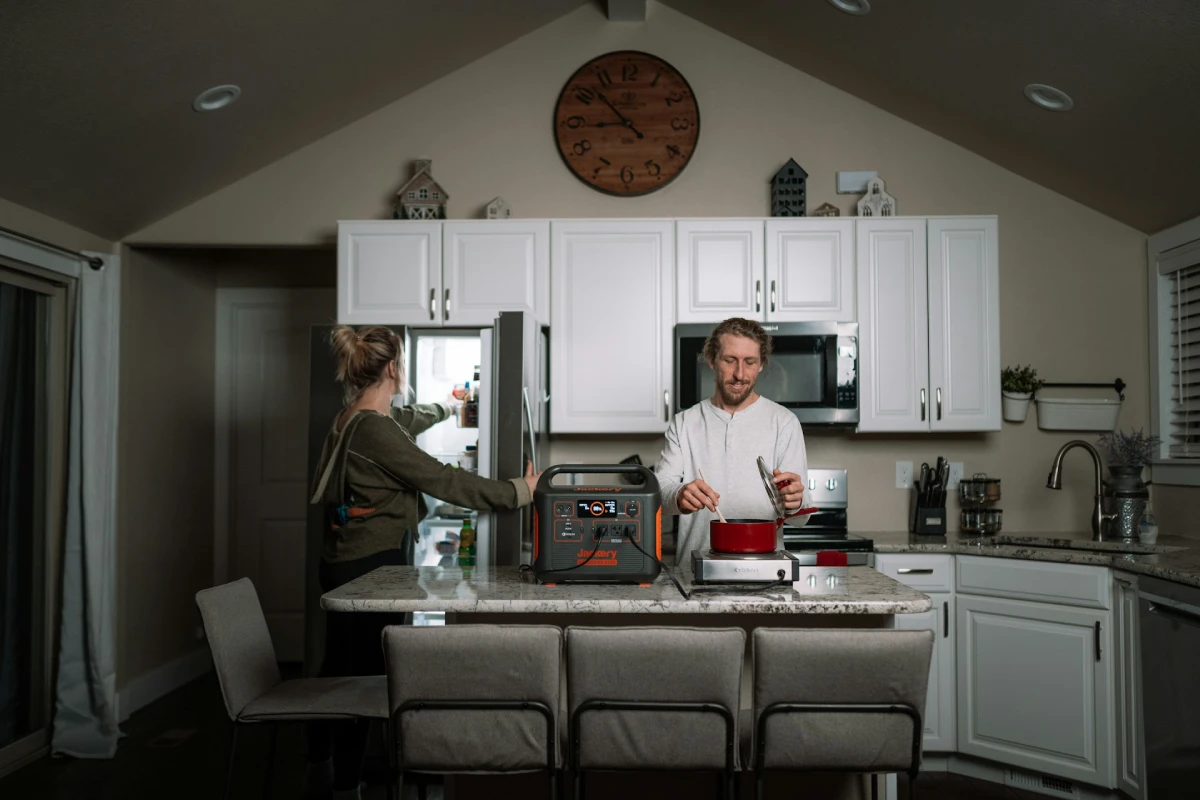

Power outages are up. Camping trips are getting longer. And people want real backup power — not just a battery pack for phones.
The Jackery Explorer 2000 v2 is built for exactly that. It’s a 2042Wh portable power station aimed at homeowners, RV travelers, and serious campers.
But the market is crowded. EcoFlow, Bluetti, Goal Zero — the choices are overwhelming. Based on our review of the specifications, performance data, and real-world use cases, here’s our take.
Is it worth buying in 2026? Let’s get straight to it.
Disclosure: This article may contain affiliate links. If you click a link and make a purchase, we may earn a commission at no additional cost to you. As an Amazon Associate, we earn from qualifying purchases. These commissions help support our independent research, testing, and content creation. Our reviews and recommendations are based on our editorial assessment and are not influenced by affiliate partnerships.
Quick Verdict: Is the Jackery Explorer 2000 v2 Worth It?
Yes — for the right buyer.
If you need home backup power, RV energy storage, or portable solar generator use, this is a strong mid-range option. It charges fast, the battery lasts thousands of cycles, and it handles most home essentials without breaking a sweat.
Best Use Cases for Jackery 2000 v2
- Home emergency backup power (fridge, lights, router)
- RV and van life power station setup
- Camping trips longer than 2 days
- Off-grid solar generator system
Who Should NOT Buy It
- Budget buyers looking for cheap portable power stations
- Lightweight campers needing <700Wh battery packs
- Anyone needing expandable battery storage
Table of Contents
- Quick Verdict: Is the Jackery Explorer 2000 v2 Worth It?
- Jackery Explorer 2000 v2 Specs Overview (2026 Updated)
- Real-World Performance: What Can the Jackery 2000 v2 Actually Run?
- Battery Capacity Explained (Wh vs Real Usable Energy)
- Solar Charging Performance (Off-Grid Capability)
- Charging Speed & Methods
- Jackery Explorer 2000 v2 vs Competitors
- Best Use Cases
- Price & Value
- Real Downsides
- Who Should NOT Buy This
- Best Alternatives
- Buying Guide: Things to Think Through First
- Final Verdict: Should You Buy the Jackery 2000 v2?
- Frequently Asked Questions
Jackery Explorer 2000 v2 Specs Overview (2026 Updated)
Here are the Jackery Explorer 2000 v2 specs you actually need to know before buying:
| Spec | Details |
|---|---|
| Battery Capacity | 2042 Wh |
| Battery Type | LiFePO4 (3,000+ cycle life) |
| AC Output | 2200W (4400W surge) |
| AC Outlets | 3x standard AC |
| USB-C Ports | 2x (100W each) |
| USB-A Ports | 2x (12W each) |
| Solar Input | Up to 1000W |
| Wall Charge Time | ~2 hours (0–100%) |
| Solar Charge Time | ~2–3 hours (4x 200W panels) |
| Weight | 50.7 lbs (23 kg) |
| Inverter Type | Pure sine wave |
This makes it a high-capacity portable power station for home backup and RV use.
👉 For official specs, check the Jackery Explorer 2000 v2 on the official website
Why LiFePO4 Matters for Power Stations
LiFePO4 (Lithium Iron Phosphate) is one of the most important upgrades in the Jackery 2000 v2 portable power station. It’s not just a technical improvement on paper — it directly affects how long the unit lasts, how safely it operates, and how reliable it remains over years of use.
Compared to traditional lithium-ion batteries, LiFePO4 offers:
- Over 3,000 charge cycles before significant capacity loss
- Better thermal stability, making it safer in high-load or hot conditions
- A much longer overall lifespan, especially for frequent use cases like home backup or RV travel
Traditional lithium-ion batteries typically last around 500–800 charge cycles before noticeable capacity loss, making LiFePO4 a major upgrade for long-term or emergency power use.
👉 Learn more about LiFePO4 battery technology and cycle life here
Real-World Performance: What Can the Jackery 2000 v2 Actually Run?
Specs on a page mean nothing without context. Here’s what this unit actually does in real life.
Refrigerator Runtime (Home Backup Power)
A standard fridge draws about 100–150W on average (not counting the startup spike). With roughly 1,735Wh of usable energy (accounting for inverter losses), you’re looking at 11–17 hours using a 2000Wh power station. For many households, that’s enough runtime to cover an overnight outage.
👉 You can read our detailed guide on the best portable power stations for refrigerator backup for runtime comparisons and top picks.
Laptop + Phone Charging (Daily Use)
Running a 65W laptop and two phones (20W each) pulls around 105W total. That gives you 16+ hours of combined use — or over 25 full phone charges in one go.
CPAP Machine
Without a heated humidifier, a CPAP uses 30–60W. That’s 28–57 hours of CPAP runtime — enough for 3 to 5 nights of sleep. A real relief if someone in your home depends on one.
TV + Internet Router
A 55-inch TV at 80W plus a router at 10–15W totals about 95W. You’d get 18+ hours of TV and internet during an outage. That’s generally enough for an evening of TV and internet use during an outage.
Heavy Appliances (Microwave, Kettle)
These work, but drain fast. A microwave pulls 900–1200W. Running it continuously would empty the battery in under 2 hours. But you don’t microwave food continuously — 3 minutes here and there is totally fine. Use them sparingly and you’ll be good.
Battery Capacity Explained (Wh vs Real Usable Energy)
Why 2042Wh Is NOT Fully Usable
Think of watt-hours (Wh) like a fuel tank. If your device uses 100 watts, a 1000Wh battery lasts 10 hours. Simple.
But here’s what most reviews miss: you don’t get 100% of the rated capacity. The inverter that converts stored power to usable AC power loses around 10–15% in the process.
So 2042Wh rated → roughly 1,735–1,840Wh of real usable energy.
Why This Matters in Real Use
How does that compare to a 1000Wh unit? You’d get roughly half the runtime on everything. For a fridge, that’s the difference between 5–7 hours (not enough) vs. 11–17 hours (enough for an overnight outage). This difference becomes significant in overnight or multi-device use cases.
Actual runtime varies based on appliance efficiency, startup surges, ambient temperature, inverter losses, and battery age.
Solar Charging Performance (Off-Grid Capability)
Solar Generator Performance in Real Conditions
The v2 accepts up to 1000W of solar input — one of the highest in its class.
With 4x 200W solar panels on a clear day, you can go from empty to full in 2–3 hours. That’s genuinely fast for solar.
With just 2 panels (400W), expect around 5–6 hours to full. That’s still enough to top up daily during a camping trip.
👉 If you’re planning a solar setup, you can read our guide on how many solar panels you actually need with real-world formulas and sizing examples.
Best Solar Setup for Camping & RV Use
For weekend camping, 2 solar panels is the sweet spot. Affordable, packable, and practical.
For RV rooftop setups, 4 panels make this unit nearly self-sustaining in summer. You can go days without worrying about running out.
Charging Speed & Methods
Wall Outlet (Fastest Method)
This is where Jackery made a big upgrade from the older Explorer 2000. You can fully charge the v2 in about 2 hours from a standard wall outlet. That’s fast and very convenient.
Car Charging (Slow Backup Option)
Works through a 12V car port, but it’s slow — expect 12–24 hours for a full charge. Fine for topping up on long drives, not useful for fast fills.
Pass-Through Charging
You can charge the unit and power your devices at the same time. Great at campsites with shore power hookups.
Jackery Explorer 2000 v2 vs Competitors
| Feature | Jackery 2000 v2 | EcoFlow Delta 2 Max | Bluetti AC200L |
|---|---|---|---|
| Capacity | 2042 Wh | 2048 Wh | 2048 Wh |
| AC Output | 2200W | 2400W | 2400W |
| Wall Charge Time | ~2 hours | ~1.8 hours | ~2 hours |
| Solar Input | 1000W | 1000W | 900W |
| Battery Type | LiFePO4 | LiFePO4 | LiFePO4 |
| Expandable Battery | No | Yes | Yes |
| Weight | 50.7 lbs | 51.9 lbs | 61.9 lbs |
| Price (From MSRP) | ~$1.2–1.5k | ~$1.2–1.4k | ~$1.2–1.6k |
| Check Price | Check Price | Check Price | Check Price |
What this tells you:
Jackery 2000 v2 is the lightest of the three. That matters when you’re loading it in and out of a car or RV.
EcoFlow Delta 2 Max supports extra battery packs — useful if you want to expand capacity later. Pricing is comparable depending on discounts.
Bluetti AC200L is slightly heavier than the Jackery, but offers higher output for the price depending on sales.
For pure value + portability, Jackery hits a strong balance. For expandability, EcoFlow is the better pick.
Best Use Cases
Home Blackout Backup Power System: Fridge, lights, phone charging, and your router — all overnight. It won’t run your whole house, but it covers what matters most.
RV Travel: Works well as a primary power source. Pair with rooftop solar and you’re nearly self-sufficient on sunny days.
Multi-Day Camping Power Station: The 2000Wh capacity, combined with solar charging, handles 3–5 day trips with ease. You won’t be rationing power.
Outdoor Power Supply: Job site lighting, power tools (light duty), and laptop charging — all handled.
👉 Read our guide on the best portable power stations for home backup for detailed comparisons and recommendations.
Price & Value
Retail pricing typically falls between $1,199 and $1,499. Jackery frequently runs sales and promotional discounts throughout the year, which can reduce the final purchase price.
That works out to roughly $0.59–$0.69 per Wh — very competitive for a LiFePO4 unit.
Over 3,000 cycles, the cost per use is extremely low. If you use it once a week, the battery will outlast most appliances in your home.
For context, EcoFlow Delta 2 Max is priced similarly depending on discounts and promotions, while Bluetti AC200L can be slightly cheaper or similar but is noticeably heavier.
For many buyers, Jackery offers a strong balance of price, weight, and overall feature set.
Real Downsides
Weight. 50.7 lbs is heavy. You need a cart to move it around the house or campsite. Not a unit you’ll carry far on foot.
No expandable battery. Unlike EcoFlow, you can’t add external battery packs later. What you buy is what you get. If your power needs grow, you’d need a second unit.
High price. There’s no way around it. This isn’t a budget buy. If you’re on a tighter budget, look at smaller Jackery models.Slow car charging. 12–24 hours via car port makes it nearly useless for fast top-ups on the road.
Who Should NOT Buy This
If you’re going on a one-night camping trip to charge your phone and run a camp light, this is overkill. A 500–700Wh unit costs half as much and weighs a third as much.
If your budget is lower, look at the Jackery Explorer 1000 v2 instead. Same great battery chemistry, half the capacity, much easier to carry.
If you need a whole-home backup that scales beyond 2kWh, you’ll want something expandable — like the EcoFlow Delta Pro 3 or Bluetti AC300.
Best Alternatives
Best for expandability: EcoFlow Delta 2 Max (~$1.2–1.4k) — supports add-on battery packs, slightly higher AC output.
Best for budget: Jackery Explorer 1000 v2 (~$600–800) — half the capacity, half the price, far easier to carry.Best for max output: Bluetti AC200L (~$1.2–1.6k) — higher AC wattage (2400W), but noticeably heavier.
Buying Guide: Things to Think Through First
Step 1 — Add up your watt needs. What do you want to run at the same time? Add those watts together. That’s your load. Make sure the unit’s output covers it.
Step 2 — Estimate your daily Wh use. Watts × hours = Wh. If your fridge uses 100W and you need 12 hours, that’s 1,200Wh. Size your battery around that.
Step 3 — Think about portability. Car or RV? 50 lbs is fine. Hiking or backpacking? Get something under 20 lbs.
Common mistakes buyers make:
- Buying too small, then being stuck during a real outage
- Forgetting inverter efficiency — plan on 85–90% usable capacity, not 100%
- Ignoring solar input specs — a higher solar input rating means faster off-grid recharging
Final Verdict: Should You Buy the Jackery 2000 v2?
The Jackery Explorer 2000 v2 is one of the most capable mid-range portable power stations available currently.
It charges fast, runs long on a single charge, pairs well with solar, and the LiFePO4 battery will last for years. For its target audience — homeowners, RV users, and serious campers — it’s competitive within its category.
The main drawbacks are weight and the lack of expandability. But for most buyers, neither of those will be dealbreakers.
Our recommendation: Buy it if you need serious backup power and plan to use it regularly. Skip it if you’re a casual user or on a tight budget.
Check Current Price on Amazon →How We Evaluate Portable Power Stations
The Home Solar & Storage Team reviews portable power stations based on battery capacity, inverter output, charging performance, portability, solar compatibility, warranty coverage, manufacturer specifications, and real-world backup power scenarios. Product availability, specifications, and pricing may change over time.
Disclaimer: Smart Energy Edge provides informational research and product reviews for educational purposes only. This content does not constitute tax, legal, financial, investment, or professional energy advice. Product performance, battery runtime, energy savings, utility costs, incentives, and operating results may vary based on location, usage patterns, environmental conditions, utility policies, and product configuration. Readers should verify specifications with manufacturers and consult qualified professionals before making significant home energy or purchasing decisions.
Frequently Asked Questions
Is the Jackery Explorer 2000 v2 worth it?
Yes. It is worth it for home backup, RV travel, and multi-day camping. For casual weekend use, it may be more powerful than you need.
What is the Jackery Explorer 2000 v2 used for?
It is used for home backup power, RV trips, camping, and off-grid solar setups where reliable electricity is needed for essential devices.
How long does the Jackery 2000 v2 battery last?
Battery life depends on usage. It can run a fridge for about 11–17 hours, laptops and phones for 16+ hours, and smaller devices for even longer.
How many hours does Jackery 2000 v2 last on a full charge?
On a full charge, it typically lasts 11–17 hours for a refrigerator, 16+ hours for laptops and phones, and 1–2 hours for high-power appliances like microwaves.
Can the Jackery Explorer 2000 v2 run a refrigerator?
Yes. It can run a standard 100–150W refrigerator for about 11–17 hours, which is enough for most overnight power outages.
Can Jackery 2000 v2 power a house during a blackout?
It can power essential appliances like a fridge, lights, router, and devices, but it cannot run an entire home. For full-home backup, multiple units or a home battery system are required.
Is Jackery 2000 v2 better than EcoFlow Delta 2 Max?
It depends on your needs. Jackery is better for portability and price, while EcoFlow is better for expandability and slightly higher output.
How long does Jackery Explorer 2000 v2 take to charge?
It takes about 2–3 hours with solar under optimal sunlight using a 4×200W panel setup. Charging time varies depending on weather and panel setup.
Can Jackery 2000 v2 run a microwave or kettle?
Yes, but only for short bursts. High-power appliances drain the battery quickly, usually within 1–2 hours of continuous use.
What size power station do I need for camping?
For short trips, smaller 500–700Wh units are enough. For multi-day camping or RV use, a 2000Wh class like the Jackery 2000 v2 is more suitable.