
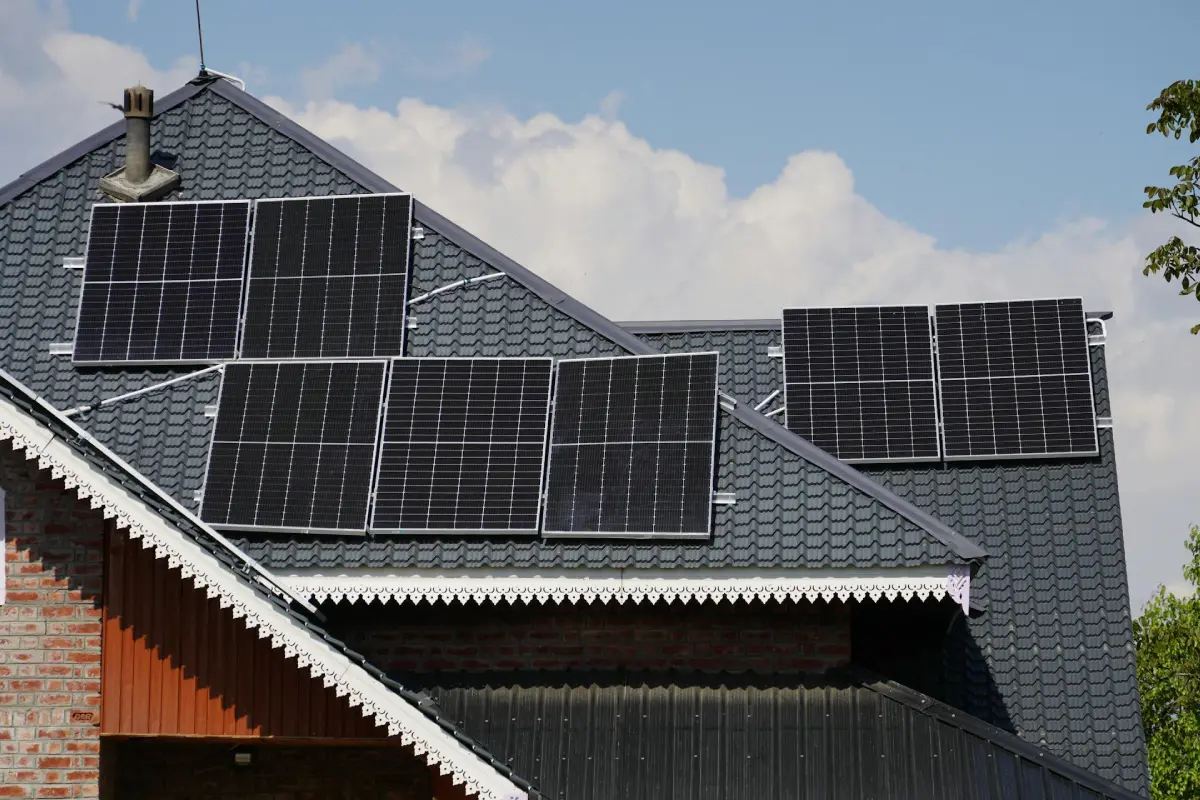

Many solar quotes still rely on older panel assumptions and outdated sizing models. Many are still based on outdated panel technology and older tax rules.
Here’s the truth: In 2026, the “average” solar estimate is dead. With the massive shift toward N-Type TOPCon efficiency (now hitting 26.6%+ in industry records) and the updated Section 48E Clean Electricity Investment Credit, high-efficiency systems can reduce panel counts by 10–25% compared to older P-Type systems.
We’ve spent years helping homeowners cut through the noise on solar. In this guide, we show you the new math — a smarter, smaller, and more profitable array that actually fits your home.
Let’s get into it.
Key Takeaways
- A 2,000 sq ft home typically needs 20–28 standard panels or 15–22 N-Type panels to fully offset energy use.
- Your actual number depends on where you live, what appliances you run, and your roof space.
- N-Type TOPCon panels produce more power per panel — so you need fewer of them.
- The Section 48E tax credit can cut your system cost by 30% or more.
- Battery storage is becoming increasingly valuable in states reducing net metering compensation.
- Always size for your actual load — not your installer’s upsell.
Table of Contents
- Key Takeaways
- Solar Panel Calculator Formula
- How Many Solar Panels to Power a House?
- Factors That Affect Solar Panel Count
- How Many Solar Panels to Run a 2,000 Sq Ft House?
- Why Most Homeowners Oversize Their Solar Systems
- N-Type vs P-Type Solar Panels
- Do You Need Battery Storage With Solar Panels?
- Building a Smarter Solar Plan
- Frequently Asked Questions
Solar Panel Calculator Formula
Not sure where to start? Use this table for a quick ballpark estimate.
| Home Profile | Annual Load (kWh) | Standard Panels (400W) | Elite N-Type (500W+) |
|---|---|---|---|
| Efficient / Gas Heat | 8,000 kWh | 20 panels | 15–16 panels |
| Average (2,000 sq ft) | 11,000 kWh | 28 panels | 21–22 panels |
| High Demand (EV + AC) | 15,000 kWh | 38 panels | 28–30 panels |
These numbers assume a south-facing roof with 4–5 peak sun hours per day. Your installer should always run your actual utility bill before sizing your system.
Solar Panel Calculator Formula
Want a fast estimate? Use this simple formula:
Number of Panels = Annual Electricity Usage (kWh) ÷ Estimated Annual Production Per Panel
Example:
- Annual home usage: 11,000 kWh
- Estimated production per 400W panel: ~400–550 kWh/year (depends on climate and sunlight)
11,000 ÷ 450 = ~24.4 panels
That means most homeowners would need about 25 panels to offset that level of electricity usage.
The 3-Step Formula: Beyond the Simple Wattage Calculation
Most online calculators oversimplify this. Here’s the real process we use.
1
Find your annual kWh usage
Pull the last 12 months from your utility bill. The modern average U.S. home uses around 10,500–11,500 kWh per year.
2
Apply your Production Ratio
This adjusts for your local sunlight. A home in Phoenix might see a ratio of 1.6. One in Seattle might see 1.1. This number accounts for real-world conditions — not lab results.
Why does this matter? Panels are rated under Standard Test Conditions (STC) — a perfect 77°F lab environment. But on your roof in July, temps hit 120°F+. That’s where NOCT (Nominal Operating Cell Temperature) ratings provide a more realistic performance benchmark. Unlike lab-based STC ratings, NOCT provides the real-world math for how your panels will actually perform in the heat of July.
Always ask your installer for NOCT output, not just STC wattage.
3
Divide and round up
Divide your annual kWh by your system’s estimated annual production per panel. Add a 10–15% buffer for losses. That’s your panel count.
How Many Solar Panels to Power a House?
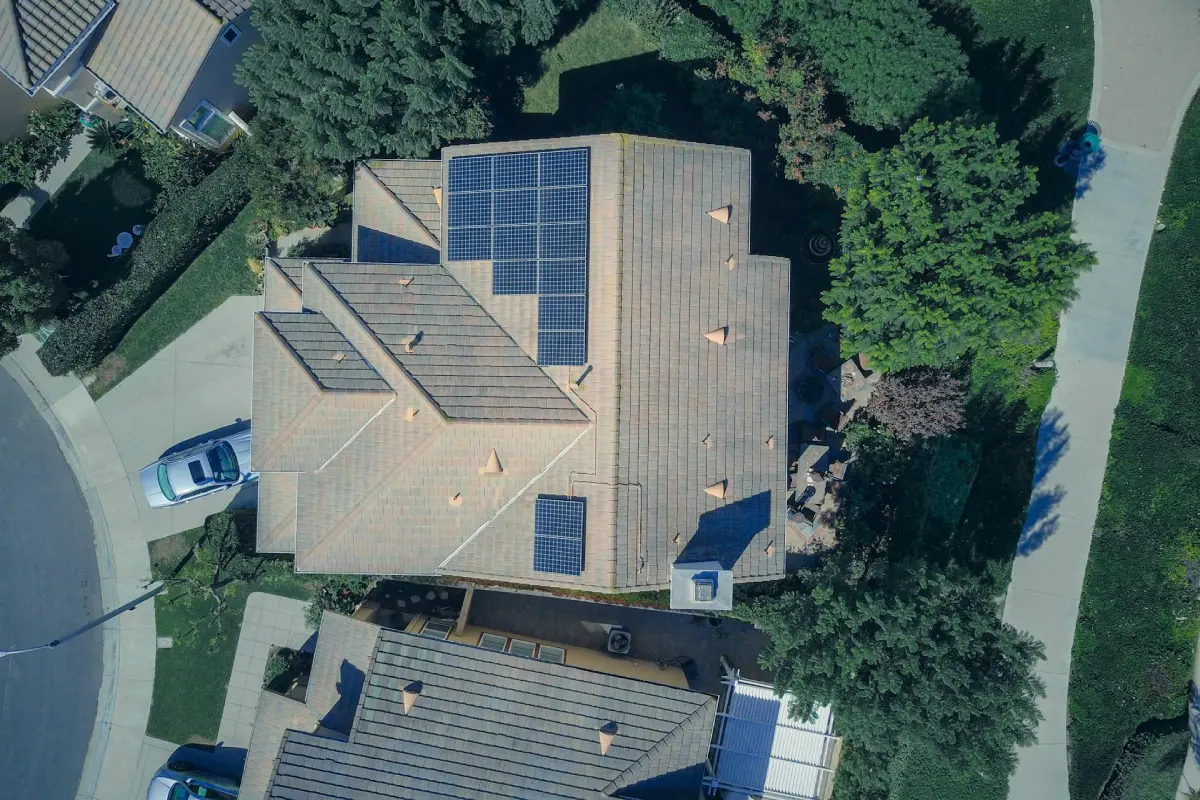
The short answer: most U.S. homes need between 20 and 35 panels to fully cover their electricity. But that range is wide for a reason. Your home’s energy profile is unique.
Let’s break down what actually drives that number.
1. Understanding Your Load Profile: From Base Load to Peak Demand
Your base load is what’s always running — your fridge, your router, your HVAC fan. Your peak demand is when everything spikes at once — dryer on, AC running, EV charging.
Most homeowners don’t realize how much phantom loads (or standby power) eat into their savings. Devices on standby — smart TVs, game consoles, older appliances — can add 500–1,000 kWh per year. Understanding what uses the most electricity in a home is often the fastest way to drop your required panel count before you even start.
That’s up to 2 extra panels you didn’t need if you address those “energy vampires” first.
One more thing to watch: inverter clipping. If your inverter is undersized for peak production, it cuts off excess power instead of sending it to the grid. A good Power Conversion System (PCS) match keeps you from wasting free energy on sunny days.
2. Why Geographic Solar Changes Your Panel Count
Where you live matters more than almost anything else.
- Tucson, AZ: Gets about 6.5 peak sun hours per day.
- Albany, NY: Gets around 4.2 peak sun hours.
That difference alone changes your panel count by 30–40%.
The Bifacial & Albedo Boost
If you’re installing bifacial panels, your location matters even more. These panels absorb light from both sides. High albedo surfaces — like white gravel, concrete, or snow — reflect extra light onto the back of the panel and boost output by 5–15%.
Optimization Tactics
- Shading analysis is non-negotiable. Even one shaded panel in a string can drag down your whole array. Ask your installer for a solar pathfinder report or a drone-based shade assessment before signing anything.
- Azimuth optimization — the compass direction your panels face — also shifts your numbers. South-facing is ideal in the U.S. But east-west splits are sometimes smarter for self-consumption, especially with Time-of-Use utility rates.
Factors That Affect Solar Panel Count
Here’s where it gets personal. Let’s look at the biggest energy drivers in modern homes.
1. Factoring in High-Drain Devices: EVs, Heat Pumps, and Induction
If you’re running an EV, a heat pump, or an induction range — your load profile looks very different from the “average” home.
- EV Charging: An EV using Level 2 charging at home adds roughly 3,000–4,500 kWh per year depending on your mileage. That’s 6–10 extra panels right there.
- Heat Pumps: A heat pump replaces a gas furnace. It uses electricity, but it’s incredibly efficient. A unit with a COP (Coefficient of Performance) of 3.5 delivers 3.5 units of heat for every 1 unit of electricity used. So switching to a heat pump may add load in winter but replace far more in gas costs. For many homeowners, the long-term economics still work strongly in its favor — but factor it into your system size.
- Induction cooking is the same story. It’s faster and cleaner than gas, but adds 200–400 kWh per year. Not huge, but worth knowing.
Rule of thumb: If you’re adding an EV or a heat pump, add 20–30% more panels to your base estimate.
2. N-Type Advantage: Why Cell Technology Redefines Your System Size
This is the biggest shift in residential solar since 2020.
For years, the industry ran on P-Type PERC panels — solid performers, but limited. They suffer from LID (Light-Induced Degradation) — a power loss of 1–3% in their first weeks of exposure to sunlight. That loss never comes back.
N-Type TOPCon panels don’t have this problem. The Tunnel Oxide Passivated Contact structure dramatically reduces electron recombination at the cell surface. Translation: the panel converts more sunlight into usable electricity.
HJT (Heterojunction Technology) panels go a step further — combining crystalline and amorphous silicon layers for even higher efficiency. Both N-Type technologies commonly hit 22–23% efficiency versus 19–21% for older P-Type. You can see how these stack up in our review of the 7 best solar panels for home.
What does this mean for you? You can fit a full offset system on a smaller roof. Fewer panels, same power. If your installer is still quoting you P-Type PERC panels, ask them why. Comparing N-Type vs P-Type solar panels now is one of the most important questions you can ask before signing.
How Many Solar Panels to Run a 2,000 Sq Ft House?
The 2,000 sq ft home is the benchmark we hear about most. Let’s go deep on it.
A typical 2,000 sq ft U.S. home uses 10,000–12,000 kWh per year. With standard 400W panels, that’s roughly 26–30 panels. With elite 500W+ N-Type panels, you’re looking at 20–24 panels.
How Much Roof Space Do Solar Panels Need?
A standard residential panel is about 65″ × 40″ — just under 18 sq ft per panel.
But you don’t get to use your whole roof. Here’s what eats into your usable space:
- Roof pitch — very steep or very flat roofs lose output efficiency
- Dormers and skylights — obvious dead zones
- Vent obstructions and HVAC equipment — often overlooked
- Fire code setbacks — most local codes require 18–36 inch clear borders around edges and ridges
After all that, a 2,000 sq ft home typically has 300–500 sq ft of usable, south-facing roof area. That fits 20–28 panels comfortably in most cases.
South-facing surface optimization is key. Even 10–15 degrees off true south costs you 2–4% in annual output. Not a dealbreaker, but worth knowing.
Roof Capacity vs. Energy Goals: Squeezing ROI from Limited Square Footage
What if your usable roof space is tight? Then your panel choice becomes critical.
High-efficiency N-Type panels let you hit your energy target with fewer panels. This is exactly where the investment pays off fastest.
You’ll also want to think about your inverter setup:
- Micro-inverters convert power at each panel individually. They’re ideal for shaded or complex roofs. If one panel is shaded, the rest keep producing at full output.
- String inverters are cheaper but link panels in series. One shaded panel drags the whole string down.
- Power Optimizers are a middle-ground — they optimize each panel but still run through a central inverter.
For shaded or multi-angle roofs, micro-inverters vs. optimizers is a real conversation worth having. For simple, unshaded south-facing roofs, a quality string inverter is often the better ROI.
Fire code setbacks also affect your racking layout. Know your local rules before getting attached to any panel arrangement.
Real-World Scenarios: 7 kW vs. 10 kW Residential Systems
A 7 kW system (roughly 17–18 panels at 400W) works well for:
- Efficient homes under 1,500 sq ft
- Low-usage households with gas appliances
- Homes with limited roof space
A 10 kW system (roughly 24–25 panels at 400W) fits better for:
- 2,000–2,500 sq ft homes
- Households running central AC in hot climates
- Early EV adopters with moderate annual mileage
Going above 10 kW usually means you’re adding EV charging, a pool pump, or planning for full electrification. That’s a smart long-term play — but right-size for your current load first.
State-by-State Solar Output Examples: Arizona vs Texas vs New York vs Washington
Your zip code changes everything. Here’s how the same 10 kW system performs across four states:
| State | Peak Sun Hours | Annual Output (10 kW) | Panels Needed (11,000 kWh) |
|---|---|---|---|
| Arizona | 6.5 hrs/day | ~23,000 kWh | 16–18 panels |
| Texas | 5.5 hrs/day | ~19,500 kWh | 18–22 panels |
| New York | 4.4 hrs/day | ~15,500 kWh | 24–28 panels |
| Washington | 3.8 hrs/day | ~13,500 kWh | 28–34 panels |
Seasonal production curves matter too. A New York home might produce 40% of its annual solar in June and July alone. That’s why battery storage becomes more valuable in cloudy northern states — you’re banking summer surplus for winter nights.
Regional irradiance differences also affect panel degradation over time — another reason to check solar panel degradation rates by brand when comparing quotes. Top-tier N-Type panels degrade at just 0.25–0.4% per year. Cheaper options can lose 0.7–1% annually. Over 25 years, that gap is significant.
Why Most Homeowners Oversize Their Solar Systems
This is something we see constantly — and it costs homeowners real money.
Installers often quote larger systems because it’s a bigger sale. But if your utility has moved to Net Metering 3.0 (Net Billing), excess power you push to the grid might pay you a fraction of retail rate. Overproducing doesn’t pay you back the way it used to, making it vital to ask: Are solar panels worth it under these new ROI rules?
The smarter move: size for your current load, then leave conduit room to expand if you add an EV or battery later. How to read your utility bill is genuinely useful here — look at your monthly peaks, not just your annual average.
N-Type vs P-Type Solar Panels
Polycrystalline panels are rarely used in modern residential installations. They max out around 17–18% efficiency and carry a P-Type cell structure that degrades faster. You’d need 4–6 extra panels to match a modern monocrystalline N-Type system. For a deeper look at how this cell structure impacts your long-term yield, check out our monocrystalline solar panels efficiency guide.
P-Type PERC was the industry workhorse from 2015–2023. It is being rapidly replaced by high-performing N-Type modules. The efficiency gap, LID immunity, and lower long-term degradation make N-Type the clear winner for any new install.
Efficiency vs. Quantity: The Financial Impact of High-Efficiency Back-Contact Cells
Higher-efficiency panels cost more upfront. But they often lower your total system cost.
Here’s why: fewer panels means fewer mounts, less wiring, less labor. The hardware savings can offset much of the premium on premium panels.
Temperature Coefficient is a spec worth knowing. It tells you how much output a panel loses per degree above 77°F. A panel with a coefficient of -0.26%/°C (like many HJT panels) performs significantly better in summer heat than one at -0.35%/°C. If you’re in Texas, Florida, or Arizona, this number directly affects your ROI.
Bifacial factor — the percentage of extra output from a panel’s rear side — ranges from 5% to 20% depending on your roof surface. Light-colored or reflective roofing materials boost this meaningfully.
Do You Need Battery Storage With Solar Panels?
Two years ago, the answer was “maybe.” Today, in many states, the answer is increasingly yes.
Net metering programs have been cut in California (NEM 3.0), Arizona, and others. That means excess solar power you send to the grid earns you less than retail rates. Without storage, you’re essentially giving away cheap power and buying it back at full price after dark.
1. Energy Independence vs. Grid-Tie: Sizing for Self-Consumption
A battery system lets you use your own solar power instead of exporting it. With Time-of-Use (TOU) arbitrage, you charge your battery during cheap solar hours and discharge it during expensive evening peak hours. In some markets, this alone can cut your bill by 40–60%.
Virtual Power Plants (VPPs) are a newer option. You enroll your battery in a utility program. During grid stress events, they draw a small amount from your battery in exchange for payments or bill credits. Companies like Tesla, Sunrun, and others are expanding these programs.
For chemistry, LFP (Lithium Iron Phosphate) batteries are the current gold standard for home storage. They’re safer, longer-lasting (3,000–6,000 cycles vs. 1,500–2,000 for older NMC chemistry), and perform better in extreme temperatures. The best battery for home solar storage is likely LFP — look at the Franklin WH, Tesla Powerwall 3, or Enphase IQ Battery 5P as solid starting points.
2. Resilience Planning: Critical Load Sub-Panels and Backup Duration
If your goal is backup power during outages — not just bill savings — you need to think about a critical load sub-panel.
This is a dedicated breaker panel for your most important circuits: fridge, lights, Wi-Fi, medical equipment.
- 10 kWh Battery: Powers these loads for 24–36 hours.
- 20–40 kWh Storage: Required for whole-home backup (usually 2-4 batteries).
3. Can You Run a House Fully on Solar?
Yes — but with a few honest caveats.
Full energy offset means your system produces as much as you consume over the course of a year. That’s achievable for most U.S. homes with the right system size.
But seasonal deficits are real. In winter, your panels produce 30–60% less than in summer. Without storage or net metering credits, you’ll still pull from the grid on short December days.
Whole-home electrification—ditching gas entirely for heat pumps, induction cooking, and an EV—is the bigger vision. While it increases your load, you benefit from the Residential Clean Energy Credit — one of many found in our federal tax credits 2026 complete list— which currently covers 30% of total system costs, including panels, batteries, and installation.
Building a Smarter Solar Plan
Here’s the honest takeaway after everything we’ve covered:
You don’t need the biggest system. You need the right system.
That means understanding your actual load, your roof’s real capacity, and the honest performance of the panels you’re buying. It means asking hard questions about N-Type vs P-Type technology, degradation rates, and what your utility’s net metering policy actually pays you.
Make sure your installer sizes the system around your actual energy usage — not generic averages. By combining high-density N-Type modules with Section 48E incentives, homeowners can often reduce effective system costs while generating more power per square foot.
Always check the DSIRE incentive database for your state’s current incentives before signing a contract.
Get at least three proposals. And make sure every quote is based on your actual utility bill — not an industry average.
The goal isn’t just solar. It’s smarter solar — and with today’s technology, the tools to get there have never been better.
Disclaimer: Smart Energy Edge provides informational research for educational purposes. This content does not constitute tax, legal, or investment advice. Incentives, tax treatment, and savings vary by location, utility policy, system design, and regulatory changes. Homeowners should consult qualified tax, legal, or financial professionals before making solar decisions.
Frequently Asked Questions
Can I just add more panels later if I buy an EV?
Technically yes, but it can get expensive. Adding a few panels later may require a new permit, additional labor, and sometimes electrical upgrades depending on your system design, which can increase overall cost per watt. The smart approach is to plan future expansion early with an inverter and system design that allows for additional capacity where possible.
Is the 30% tax credit still real for 2026?
The rules have changed. As of January 1, 2026, the direct federal tax credit for homeowners who purchase systems outright (Section 25D) may no longer be available under certain policy updates. However, some homeowners may still access savings through Third-Party Ownership (Leases or PPAs). In these models, the solar provider may benefit from federal incentives such as Section 48E and may pass part of the savings to you through lower monthly payments. Always confirm the latest state-level incentives and contract terms with a professional before signing.
Why does my neighbor have 20 panels and I need 30?
Square footage is not a reliable way to size solar. Solar is sized by usage, not house size. If your neighbor has gas heat and you have an electric furnace or a pool pump, you may need more panels. Also, higher-efficiency N-Type panels can reduce the total number of modules needed compared to older lower-efficiency systems.
Will 400W panels actually give me 400W?
400W is a lab-based rating under ideal conditions. In real-world conditions (heat, dust, clouds, and angle), output will vary throughout the day. Instead of relying only on the nameplate rating, installers typically estimate production using real-world performance models that account for local conditions and system losses.