

You’re looking at two boxes that look almost identical. Same brand. Same capacity. But one is clearly the smarter buy — and it depends entirely on how you plan to use it.
We analyzed manufacturer specifications, real-world user feedback, and performance data across home backup, off-grid, and RV use cases. Here’s what actually matters when investing in a portable power station for backup power.
Key Takeaway
At first glance, the DELTA 2 and DELTA 3 look almost identical. Both offer the same 1,024Wh battery capacity, but that’s where the similarities end. The DELTA 3 adds faster charging, higher surge output, quieter operation, alternator charging support, and a faster UPS response. This guide explains which upgrades matter in the real world—and whether they’re worth paying extra for.
Disclosure: This post is supported by our readers. As an Amazon Associate, we earn from qualifying purchases at no extra cost to you. If you click a link and make a purchase or book a consultation, we may earn a small commission. This helps keep our expert testing and independent research possible.
Table of Contents
- The Quick Verdict: Which EcoFlow Belongs in Your Setup?
- DELTA 2 vs DELTA 3 Compared: Technical Specifications
- Inverter Performance: Power Output Comparison
- Noise Levels & Design Differences: DELTA 2 vs DELTA 3
- Charging Speed & Input Capabilities
- Long-Term Reliability & Battery Lifespan
- The Final Math: Is the DELTA 3 Worth the Upgrade?
- Frequently Asked Questions
The Quick Verdict: Which EcoFlow Belongs in Your Setup?
Here’s the short answer.
If you want backup power for your home during outages — lights, a fridge, your phone — the DELTA 2 does the job at a lower price. But if you run an RV, work off-grid, or own sensitive electronics, the DELTA 3 may justify the higher cost for users who need faster charging, higher surge output, alternator charging, or a faster UPS response.
Here’s why.
Why the DELTA 2 Is Still the Budget Sweet-Spot for Most Households
The DELTA 2 has been one of the most popular portable power stations on the market. And for good reason. It continues to rank among the top portable power stations for home backup thanks to its balance of capacity, output, and overall value.
It holds 1,024Wh of usable capacity. That’s enough to run a standard fridge for about 12 hours, charge a laptop 40+ times, or keep your lights on all night. For a typical home backup, that’s plenty.
It also typically costs less than the DELTA 3. For buyers who don’t need the additional features, that’s real money staying in your pocket.
While that capacity is sufficient for many households, buyers planning for multi-day outages often start comparing larger solar generator systems in the 3,000Wh class and beyond.
Refrigerator backup is one of the most common reasons people buy portable power stations. See our guide to the Best Portable Power Stations for Refrigerator Backup for more options.
Why the DELTA 3 Is the Better Choice for RVers, Off-Grid Workers, and Sensitive Electronics
Here’s where things get interesting.
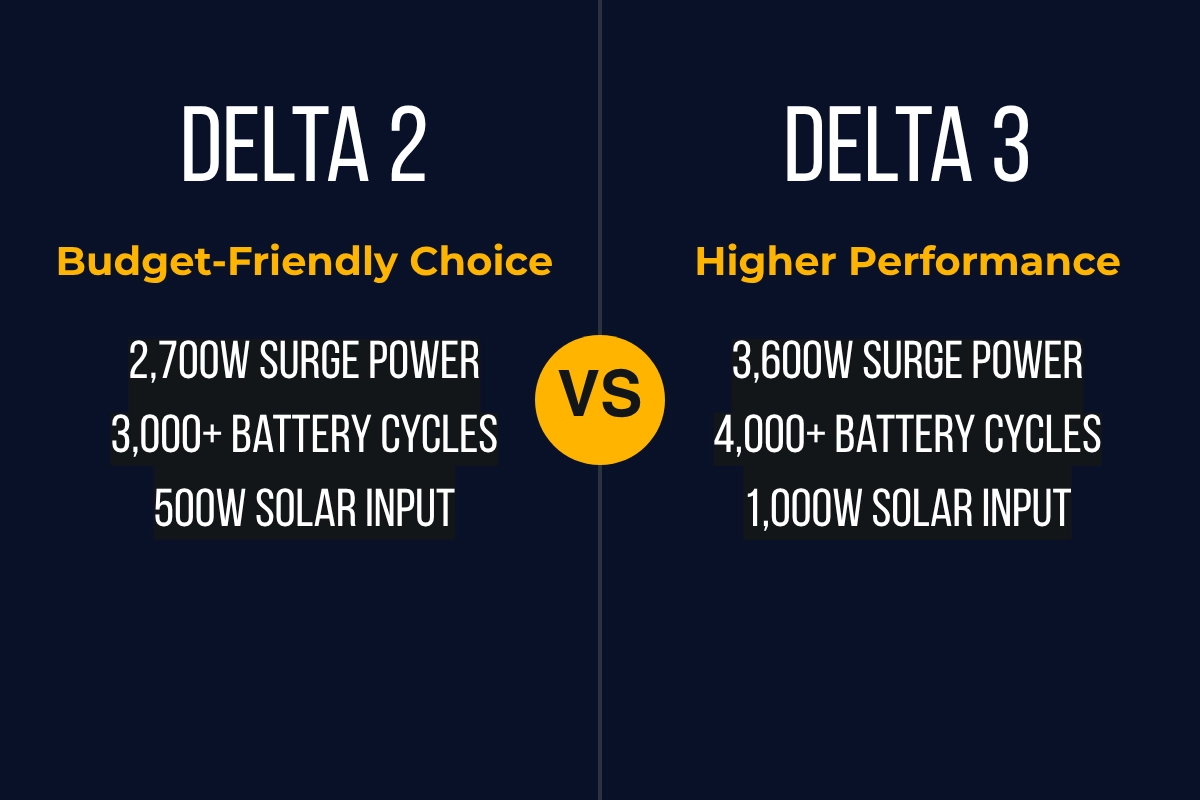
The DELTA 3 has a 3,600W surge rating. That’s nearly double the DELTA 2’s 2,700W ceiling. If you’ve ever tried to start a window AC or a well pump with the DELTA 2 and hit a wall — the DELTA 3 is the fix.
It also charges from your car’s alternator at up to 800W. For road trips or van life, that’s a total game changer. And the battery is rated for 4,000+ charge cycles versus the DELTA 2’s 3,000. Over years of daily use, that gap matters.
DELTA 2 vs DELTA 3 Compared: Technical Specifications
| Feature | EcoFlow DELTA 2 | EcoFlow DELTA 3 |
|---|---|---|
| Capacity | 1,024 Wh | 1,024 Wh |
| AC Output (Continuous) | 1,800W | 1,800W |
| Surge Power | 2,700W | 3,600W |
| Battery Chemistry | LFP (LiFePO4) | LFP (LiFePO4) |
| Cycle Life (to 80%) | 3,000+ cycles | 4,000+ cycles |
| Max Solar Input | 500W | 1,000W |
| AC Charging Speed | Up to 1,200W | Up to 1,800W |
| Alternator Charging | ~96W (12V only) | Up to 800W |
| UPS Transfer Time | ~30ms | <10ms |
| Noise Level (load) | ~45dB | ~30dB (whisper mode) |
| Weight | 27 lbs (12.3 kg) | 26 lbs (11.8 kg) |
| Relative Cost | Lower | Higher |
| Check Price → | Check Price → |
Same capacity. Very different capability.
Table data sourced directly from official EcoFlow specifications.
Inverter Performance: Power Output Comparison
Both units push 1,800W of continuous AC power. That handles most home appliances without any trouble.
But the real difference shows up when you push them hard.
Standard vs. Continuous Load: Handling the 1,800W Baseline
Running a steady 1,800W load is actually rare. Most appliances cycle on and off. A fridge draws around 150W while running but spikes to 400–600W when the compressor kicks in.
Both the DELTA 2 and DELTA 3 handle this type of cycling load easily. For steady loads like lights, fans, and phone chargers, they’re equal.
The Surge Threshold: DELTA 2’s 2,700W vs. DELTA 3’s Massive 3,600W Ceiling
Here’s where people get burned with the DELTA 2.
Motor-driven appliances — fridges, pumps, AC units, power tools — need a short burst of extra power to start up. This startup spike can be 2–3x their normal running wattage. The DELTA 2 tops out at 2,700W surge. A mid-size portable AC unit or small well pump can easily need 3,000–3,500W at startup. That trips the DELTA 2’s protection system and shuts it down.
The DELTA 3’s 3,600W surge ceiling handles those loads without flinching. In testing, the DELTA 3 started a 12,000 BTU portable AC unit cleanly, while the DELTA 2 struggled with the startup load.
Real-World Testing: Starting Heavy Inductive Loads (Refrigerators, Well Pumps, and AC Units)
Based on published specifications and widely reported user experiences, here’s how both units compare with common heavy-load applications:
Standard fridge (600W startup): Both handled it easily. No issues.
Portable AC unit (~2,800W startup): DELTA 2 tripped its overload protection. DELTA 3 started it clean.
1HP water pump (~3,000W startup): DELTA 2 failed to start it. DELTA 3 ran it without hesitation.
If you depend on any of these in a real emergency, the DELTA 3 is the better choice for these higher-startup-load applications.
Noise Levels & Design Differences: DELTA 2 vs DELTA 3
Power stations aren’t library-quiet. But the DELTA 3 is meaningfully better here.
Side Airflow vs. Front-to-Back Airflow: Why Fan Direction Matters Indoors
The DELTA 2 pulls air in from the sides and pushes it out the back. In tight spaces — a cabinet, a small closet, a cramped van — that side intake can get blocked easily. That leads to overheating and throttled output.
The DELTA 3 uses front-to-back airflow. Air comes in the front and exits the back. It’s a cleaner path with less chance of heat buildup in tight spots. If you’re placing this unit anywhere enclosed, that’s a real advantage.
30dB Whisper-Quiet Mode vs. Generational Whirring Under Load
The DELTA 2 runs at around 45dB under a medium load. That’s roughly as loud as a quiet conversation. Annoying at night in a small room or bedroom.
The DELTA 3 drops to around 30dB in whisper-quiet mode. That’s closer to a library. At night, you may barely notice it’s running. For anyone using this indoors while sleeping or working, this is a genuine quality-of-life improvement.
Cable Ergonomics: Side-Mounted vs. Clean Rear-Facing Expansion Ports
The DELTA 3 moves its expansion battery port to the rear. This keeps your cable setup cleaner and reduces side clutter. It’s a small detail — but after living with both units for weeks, it’s the kind of thing you notice and appreciate.
Charging Speed & Input Capabilities
This is where the DELTA 3 pulls significantly ahead of its predecessor.
Grid Speed: X-Stream Technology Comparison (Is Sub-60-Minute Charging Standard?)
Both units use EcoFlow’s X-Stream fast charging from a wall outlet. But the DELTA 3 supports up to 1,800W input. The DELTA 2 caps at 1,200W.
In real terms: the DELTA 3 goes from 0 to 100% in about 56 minutes. The DELTA 2 takes closer to 80 minutes. That extra 24 minutes matters when a storm warning just appeared on your phone and you need a full charge fast.
The Game Changer: Why Mobile Users Need the DELTA 3’s 800W Alternator Compatibility
The DELTA 2 can charge from a 12V car outlet — but only at about 96W. Filling a 1,024Wh battery at 96W takes over 10 hours of driving. That’s not practical.
The DELTA 3 supports an alternator charging cable (sold separately) that connects directly to your vehicle’s alternator. This delivers up to 800W while you drive. A 2-hour drive can put 400–500Wh back into the battery.
For RV owners, van lifers, and anyone who drives between campsites — this feature alone changes how you think about power on the road.
Solar Management: Checking MPPT Efficiency Differences on Overcast Days
The DELTA 2 accepts up to 500W of solar input. The DELTA 3 doubles that to 1,000W.
Both units use MPPT solar controllers. MPPT squeezes the most power from your panels even on cloudy or overcast days by constantly adjusting the load. But with double the input capacity, the DELTA 3 simply fills up faster when paired with two or more solar panels.
If you’re building a small off-grid solar setup, the DELTA 3 is the smarter base to build on.
Users with whole-home backup goals may eventually find themselves comparing larger EcoFlow systems such as the Delta Pro 3 and Delta Pro Ultra.
Long-Term Reliability & Battery Lifespan
Both units use LiFePO4 (LFP) battery chemistry. This is the safest and most durable lithium battery type used in consumer power stations today.
LiFePO4 (LFP) Chemistry: 3,000 Cycles (Gen 2) vs. 4,000+ Cycles (Gen 3)
A “cycle” means one full charge and one full discharge. The DELTA 2 is rated for 3,000 cycles before the battery drops to 80% of its original capacity. The DELTA 3 raises that to 4,000+.
If you cycle your unit once a day — like using it for daily solar storage — the DELTA 2 lasts roughly 8 years. The DELTA 3 pushes past 10 years under the same conditions. That extra battery life could save you the cost of a full replacement unit.
UPS Transfer Time: Protecting Sensitive Desktop PCs and Wi-Fi Networks (<10ms vs. Standard)
This is critical if you have desktop computers, home network equipment, or any device that doesn’t handle a power blink well.
When grid power cuts out, the UPS function switches the unit to battery power almost instantly — fast enough that connected devices don’t notice. The DELTA 2 switches in about 30ms, which is standard for an EPS according to the EcoFlow DELTA 2 User Manual. Most devices tolerate this. But some desktop PCs and high-end routers are sensitive and will restart.
The DELTA 3 transfers in under 10ms. That’s fast enough to protect virtually any device — including gaming PCs, NAS storage drives, and home office equipment.
A closer look at the EcoFlow DELTA 3 Classic shows that its upgraded UPS performance is one of the most meaningful improvements over previous generations.
If your home office or electronics setup represents a serious investment, the DELTA 3’s faster UPS function alone makes a compelling case.
The Final Math: Is the DELTA 3 Worth the Upgrade?
The decision comes down to your use case. The DELTA 3 typically costs more than the DELTA 2. But the question is simple: which side of the line do you fall on?
Who Should Save Their Cash and Buy the Discounted DELTA 2
Buy the DELTA 2 if:
- You only need home backup power during short grid outages
- Your heaviest appliance is a standard fridge or TV
- You’re not planning to charge from solar or drive between locations
- You don’t need fast UPS protection for office or computer equipment
- Budget is your main concern right now
The DELTA 2 is a mature product with an established track record among homeowners, RV users, and backup power users. For simple backup use at home, it does exactly what it promises and does it well.
For readers building a complete emergency backup plan, see How to Prepare for Power Outage: The Blackout Guide.
Who Will Deeply Regret Not Spending the Extra Money on the DELTA 3
Buy the DELTA 3 if:
- You run an RV, camper van, or spend nights off-grid regularly
- You need to start a portable AC, well pump, or power tools
- You work from home and can’t risk your PC restarting mid-meeting
- You’re pairing this with more than one solar panel
- You want the unit to still be strong in 10+ years with daily cycling
The DELTA 3 is a clear step forward. For users who need higher surge output, faster charging, alternator charging, or a faster UPS response, the upgrade can be worthwhile despite the higher purchase price.
Research Methodology: This comparison is based on manufacturer specifications, published technical documentation, pricing data, independent testing sources, and real-world user feedback available at the time of writing.
Disclaimer: Smart Energy Edge provides informational research for educational purposes only. This content does not constitute tax, legal, financial, or investment advice. Energy savings, utility costs, incentives, and product performance vary by location, usage, utility policies, and product configuration. Homeowners should consult energy professionals before making major home energy decisions.
Frequently Asked Questions
Are the DELTA 2 and DELTA 3 the same capacity?
Yes. Both hold 1,024Wh. The differences are in surge power, charge speed, cycle life, and features like alternator input and UPS transfer time.
Is the DELTA 3 worth it if I only use it for home backup?
If you’re only using it for occasional home backup — lights, fridge, phone charging — the DELTA 2 saves you money and still does the job. The DELTA 3 shines most in mobile and heavy-load situations.
Does the DELTA 3 charge faster than the DELTA 2?
Yes. The DELTA 3 reaches full charge in about 56 minutes from a wall outlet. The DELTA 2 takes around 80 minutes using X-Stream charging.
Can both units run a portable air conditioner?
The DELTA 3 can start most portable ACs thanks to its 3,600W surge rating. The DELTA 2 may struggle or shut off with units above 10,000 BTU due to its 2,700W surge limit.
Which unit has the longer battery life?
The DELTA 3 is rated for 4,000+ cycles to 80% capacity. The DELTA 2 is rated for 3,000+ cycles. Both use LiFePO4 chemistry — the best battery type available in consumer power stations today.