

If you need the short answer right now, here it is.
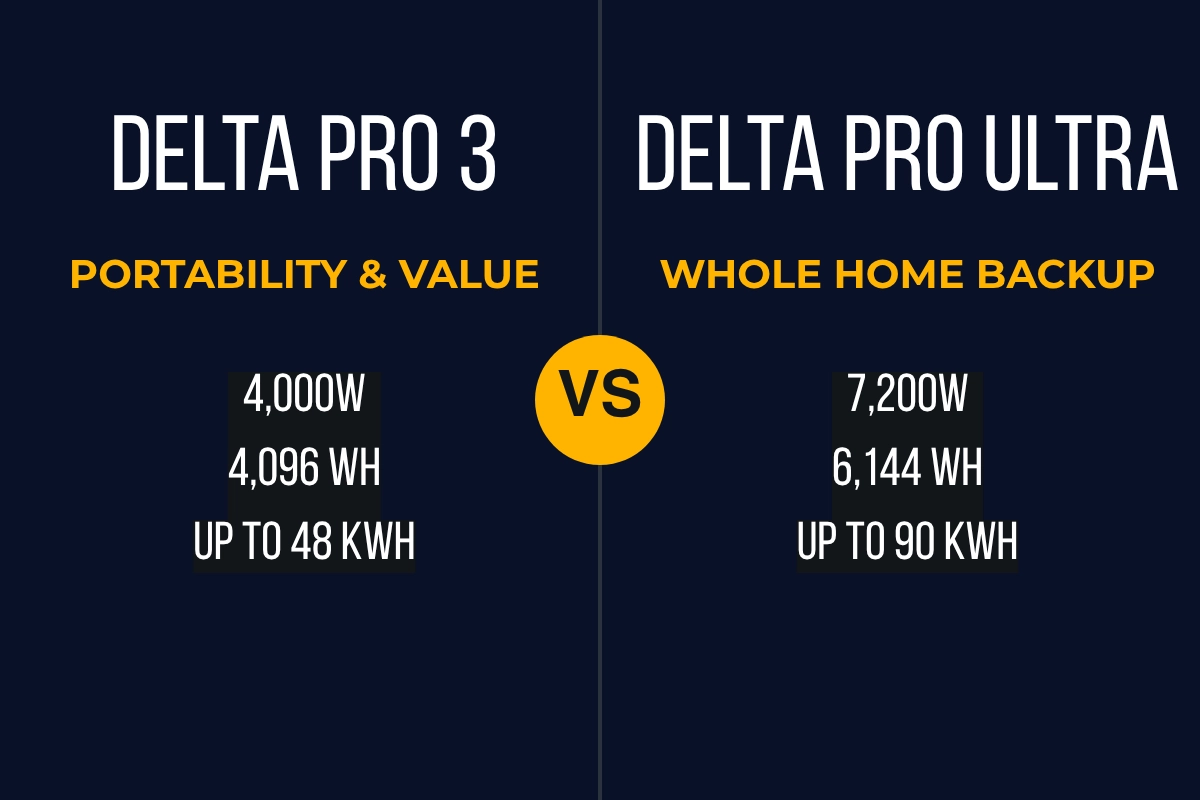
The Delta Pro Ultra wins for maximum home backup power and serious expansion. The Delta Pro 3 wins for portability, flexibility, and overall value.
The best choice really comes down to one question: Do you need to back up your whole home, or do you need power you can move around?
We’ve researched and analyzed portable power stations and home battery backup systems across a wide range of outage, solar charging, and off-grid scenarios.
This guide cuts through the noise and tells you exactly which unit fits your situation.
Disclosure: This post is supported by our readers. As an Amazon Associate, we earn from qualifying purchases at no extra cost to you. If you click a link and make a purchase or book a consultation, we may earn a small commission. This helps keep our expert testing and independent research possible.
Table of Contents
- EcoFlow Delta Pro 3 vs Delta Pro Ultra at a Glance
- Delta Pro 3 vs Delta Pro Ultra: Key Differences
- Battery Capacity and Expandability
- Power Output and Appliance Performance
- Solar Charging Comparison
- Home Backup Performance During Power Outages
- Portability and Ease of Use
- Off-Grid Living and Cabin Use
- Installation and Expansion Ecosystem
- Noise Levels, Reliability, and User Experience
- Price and Overall Value
- Who Should Buy the EcoFlow Delta Pro 3?
- Who Should Buy the EcoFlow Delta Pro Ultra?
- EcoFlow Delta Pro 3 vs Delta Pro Ultra: Final Verdict
- Frequently Asked Questions
EcoFlow Delta Pro 3 vs Delta Pro Ultra at a Glance
Quick Comparison Table
| Feature | Delta Pro 3 | Delta Pro Ultra |
|---|---|---|
| Battery Capacity | 4,096 Wh (4 kWh) | 6,144 Wh (6 kWh) base |
| Expandable Capacity | Up to 12 kWh | Up to 90 kWh |
| Continuous Output | 4,000W | 7,200W |
| Surge Output | 8,000W | 14,400W |
| Solar Input | 2,600W | 5,600W |
| Weight | ~60 lbs (27 kg) | ~84 lbs (modular) |
| UPS Capability | Yes (<30ms) | Yes (<20ms) |
| Expansion Batteries | 2 batteries max | Up to 15 batteries |
| Best For | Portability, RV, medium backup | Whole-home backup, off-grid |
| Pricing | Check Price | Check Price |
Delta Pro 3 vs Delta Pro Ultra: Key Differences
- Delta Pro 3 is portable; Delta Pro Ultra is designed for permanent installation.
- Delta Pro 3 offers 4,000W output; Delta Pro Ultra delivers 7,200W.
- Delta Pro 3 expands to 12 kWh; Delta Pro Ultra expands to 90 kWh.
- Delta Pro 3 accepts 2,600W solar input; Delta Pro Ultra accepts 5,600W.
- Delta Pro 3 is better for RVs and travel; Delta Pro Ultra is better for whole-home backup.
Fast Verdict
- Best for RV users: Delta Pro 3
- Best overall home backup: Delta Pro Ultra
- Best portability: Delta Pro 3
- Best value for most buyers: Delta Pro 3
- Best off-grid option: Delta Pro Ultra
Battery Capacity and Expandability
Delta Pro 3 Battery Capacity
The Delta Pro 3 starts with a solid 4,096 Wh (about 4 kWh) of usable power. That’s enough to run your fridge, lights, and phone chargers through most overnight outages.
It uses LFP (lithium iron phosphate) battery cells. Those cells are safer, last longer, and hold up better through charge cycles than older battery types.
Delta Pro Ultra Battery Capacity
The Delta Pro Ultra starts at 6,144 Wh (6 kWh) per battery module. The base setup already gives you 50% more storage than the Delta Pro 3 right out of the box.
That bigger base capacity matters a lot during multi-day blackouts. Your essential circuits stay powered longer without needing a recharge.
Maximum Expandable Capacity Comparison
Here’s where the gap really opens up.
The Delta Pro 3 expands to 12 kWh with two extra batteries. You can pair it with EcoFlow’s Smart Generator for extended runtime during prolonged outages.
The Delta Pro Ultra expands all the way to 90 kWh with up to 15 expansion batteries. That’s nearly eight times the Delta Pro 3’s maximum standalone storage.
Which System Stores More Energy?
The Delta Pro Ultra wins this one — and the difference is substantial. If you’re serious about keeping your whole home powered for multiple days, the Delta Pro Ultra offers the highest expandable storage capacity in EcoFlow’s portable power ecosystem.
For most families dealing with a 1–2 day outage, the Delta Pro 3 with expansion batteries does the job at a much lower cost.
Power Output and Appliance Performance
Delta Pro 3 Output Power
The Delta Pro 3 puts out 4,000W of continuous AC power. Thanks to EcoFlow’s X-Boost technology, it can actually handle appliances up to 4,600W by optimizing the draw.
It supports both 120V and 240V output. That means you can run larger appliances that most power stations can’t touch.
Delta Pro Ultra Output Power
The Delta Pro Ultra doubles the output at 7,200W continuous. Its surge capacity hits 14,400W — enough to start heavy motors without tripping out.
It also supports 120V and 240V natively. For running multiple heavy loads at once, the Ultra is simply in a different league.
What Appliances Can Each Model Run?
| Appliance | Delta Pro 3 | Delta Pro Ultra |
|---|---|---|
| Refrigerator (700W) | ✅ Yes | ✅ Yes |
| Freezer (500W) | ✅ Yes | ✅ Yes |
| Microwave (1,200W) | ✅ Yes | ✅ Yes |
| Air conditioner (3,500W) | ✅ Yes (with X-Boost) | ✅ Easily |
| Well pump (2,000W+) | ✅ Yes | ✅ Easily |
| Electric oven (5,000W) | ⚠️ Limited compatibility | ✅ Yes |
Which Handles Heavy Loads Better?
The Delta Pro Ultra wins here. If you need to run an electric dryer, a large central AC, or multiple heavy appliances at the same time, the Ultra handles it without approaching its output limits.
The Delta Pro 3 is surprisingly capable for its size. But it has real limits with appliances over 4,000W.
Solar Charging Comparison
Delta Pro 3 Solar Input Capability
The Delta Pro 3 accepts up to 2,600W of solar input through its two PV ports. One port handles high-voltage panels (up to 1,600W). The second handles low-voltage panels (up to 1,000W).
That gives you solid flexibility when mixing different panel types.
Delta Pro Ultra Solar Input Capability
The Delta Pro Ultra more than doubles that with 5,600W of solar input. It handles much larger solar arrays. This makes it the better choice for homes already running a rooftop solar setup.
Charging Speed Differences
With a full 2,600W solar array, the Delta Pro 3 can recharge in approximately 2–3 hours under ideal conditions. Real-world charging times are typically longer depending on weather, panel orientation, and actual solar output. That’s genuinely fast for a unit this size.
The Delta Pro Ultra’s 5,600W solar input fills its base 6 kWh battery in about the same time. But it really shines when charging expanded storage — you can replenish a 12–18 kWh setup in a single sunny day.
Which Is Better for Solar-Powered Homes?
For homes with larger rooftop arrays or serious off-grid solar setups, the Delta Pro Ultra is the better match. Its 5,600W solar input means less wasted capacity from your panels.
For a home with a modest panel array (6–10 panels), the Delta Pro 3’s 2,600W input is more than enough.
Home Backup Performance During Power Outages
Delta Pro 3 for Home Backup
The Delta Pro 3 is a strong backup choice for most families. With 4 kWh of base storage and expansion to 12 kWh, it can power your essential circuits for 12–24 hours.
A typical setup including a fridge, several lights, a router, and phone chargers can run through a full overnight outage without issue.
Delta Pro Ultra for Whole-House Backup
The Delta Pro Ultra is built for whole-home backup. Pair it with EcoFlow’s Smart Home Panel 2 and it integrates directly into your home’s breaker box.
With 12–30 kWh of storage, it can keep most of your home running for 1–3 days between recharges. That includes larger loads like an HVAC system, water heater, and kitchen appliances.
Runtime Examples During Blackouts
Delta Pro 3 (base 4 kWh):
- Fridge + lights + router = ~18–24 hours
- Add a window AC unit = ~4–6 hours
- With 2 expansion batteries (12 kWh) = 3x those runtimes
Delta Pro Ultra (base 6 kWh, expanded to 12 kWh):
- Essential home circuits = 24–48+ hours
- Full-home backup with solar recharging = near-continuous coverage
Which Provides Better Emergency Preparedness?
For true emergency preparedness, the Delta Pro Ultra provides greater energy security during extended outages. It’s designed for multi-day outages without depending on grid power at all.
The Delta Pro 3 handles most real-world outages well. For longer storms or serious grid failures, you’d need to expand it or rely on solar charging to keep up.
Portability and Ease of Use
Size and Weight Comparison
The Delta Pro 3 weighs around 60 lbs (27 kg). It has built-in wheels and a pull handle. One person can move it around the house with reasonable effort.
The Delta Pro Ultra is significantly heavier than the Delta Pro 3 and intended for stationary installation. Moving it is a two-person job. The expansion batteries add even more weight.
Moving the Units Around the House
The Delta Pro 3 rolls easily from room to room. It’s designed to be repositioned — bedroom during a storm, garage for tools, living room for the TV.
The Delta Pro Ultra is more of a permanent install. Most buyers set it up in one spot and leave it there.
Transportation for RV and Travel Use
If you travel in an RV or take frequent camping trips, the Delta Pro 3 is the clear choice. It loads into a truck bed or RV storage bay without needing a second person.
The Delta Pro Ultra was not designed for travel. Its weight and size make it impractical for anything that moves.
Which Is More Portable?
The Delta Pro 3 wins this category without question.
Off-Grid Living and Cabin Use
Delta Pro 3 for Off-Grid Applications
The Delta Pro 3 works very well for weekend cabins, van builds, and part-time off-grid setups. With 12 kWh of storage and 2,600W solar input, it covers most daily energy needs for a small household.
It’s also easy enough to install yourself without professional help.
Delta Pro Ultra for Long-Term Off-Grid Living
For full-time off-grid living, the Delta Pro Ultra is the more serious tool. Its 90 kWh expansion capacity and 5,600W solar input mean you can store enough energy to ride out multiple cloudy days.
Paired with a large solar array, it can function as a complete home energy storage system.
Which Handles Continuous Daily Energy Needs Better?
For full-time, high-demand off-grid living, the Delta Pro Ultra handles it better. The Delta Pro 3 is fine for light-to-moderate off-grid use. But heavy daily loads will push it to its limits.
Installation and Expansion Ecosystem
Smart Home Integration
Both units connect to the EcoFlow app. You can monitor battery levels, set charge schedules, and track solar input from your phone.
The Delta Pro Ultra connects to Smart Home Panel 2 for full home integration. That enables automatic switching during outages, circuit prioritization, and true whole-home backup.
Expansion Batteries
The Delta Pro 3 supports up to 2 extra batteries for a max of 12 kWh. The Delta Pro Ultra supports up to 15 batteries for up to 90 kWh.
Both use LFP batteries rated for 4,000+ charge cycles to 80% capacity. That’s roughly 10+ years of daily use.
Generator Compatibility
Both units support EcoFlow’s Smart Generator. The Delta Pro 3 works with the SG4000 dual-fuel generator for extended off-grid coverage.
The Delta Pro Ultra also supports generator input as a backup charging source.
Home Panel Integration
The Delta Pro Ultra has a clear edge here. It’s designed to connect directly to your home’s electrical panel. The Smart Home Panel 2 integration turns it into a permanent backup power system.
The Delta Pro 3 can integrate with a simpler home panel setup but is better suited for plug-in use.
Future Upgrade Potential
Both systems are designed to grow with your needs. The Delta Pro 3 is more limited on expansion. The Delta Pro Ultra can scale up to near utility-level storage over time.
Noise Levels, Reliability, and User Experience
Cooling System and Fan Noise
The Delta Pro 3 runs quietly at low loads. Under 600W, you’ll barely notice it. Under heavy load, the fan kicks in but stays at a reasonable level.
The Delta Pro Ultra is similar — quiet during normal use and louder when working hard. Neither unit will disturb your sleep from the next room.
Mobile App Features
The EcoFlow app works well for both units. You can see real-time power draw, set charging limits to preserve battery health, and get storm alert notifications.
The app sends automatic alerts when bad weather is approaching. That lets you pre-charge before a storm hits.
Overall User Experience
Both units are easy to use right out of the box. Plugging in and getting power takes minutes. The setup process is simple enough for someone who’s never used a power station before.
Price and Overall Value
Initial Purchase Cost
- Delta Pro 3: Positioned as a mid-range portable power station with a lower entry cost compared to modular home backup systems.
- Delta Pro Ultra: Higher upfront investment due to its modular inverter-and-battery design, especially when configured for whole-home backup.
The Delta Pro 3 requires a significantly lower initial investment, making it more accessible for most households. The Delta Pro Ultra sits in a higher price category, particularly when expanded with additional battery modules.
Cost Per kWh Analysis
At scale, the Delta Pro Ultra generally offers better value per unit of stored energy when multiple batteries are added.
However, the Delta Pro 3 delivers stronger value for users who do not require large expandable storage or whole-home integration.
Long-Term Value Assessment
The Delta Pro 3 is the better value for most users due to its lower entry barrier and strong performance for essential backup and portable use cases.
The Delta Pro Ultra becomes more cost-efficient over time when expanded into a larger home energy storage system, particularly for users prioritizing long-duration backup or solar integration.
Is Delta Pro Ultra Worth the Extra Cost?
Yes — but only if you need what it offers. If you’re running whole-home backup, large solar arrays, or long-term off-grid storage, the Ultra is worth every dollar.
If you’re protecting essential circuits during outages or powering an RV, the Delta Pro 3 gives you better value.
Who Should Buy the EcoFlow Delta Pro 3?
Ideal for:
- RV owners and frequent travelers
- Homeowners needing reliable essential-circuit backup
- Campers and off-grid weekenders
- Anyone who needs to move their power station regularly
- Buyers who want great performance without the premium price
Not ideal for:
- Whole-home backup for large households
- Running multiple high-wattage appliances at once
- Full-time off-grid living with heavy energy demands
Who Should Buy the EcoFlow Delta Pro Ultra?
Ideal for:
- Homeowners who want full whole-home backup
- Properties with large solar arrays
- Full-time off-grid living or remote cabins
- Long-term emergency preparedness with multi-day coverage
- Anyone planning to build a serious home energy storage system
Not ideal for:
- Frequent moving or transportation
- Budget-conscious buyers
- Light or occasional backup needs
EcoFlow Delta Pro 3 vs Delta Pro Ultra: Final Verdict
Buy Delta Pro 3 If…
You want powerful, portable backup power that one person can move. You travel in an RV. You need to protect essential appliances during outages without spending $5,000+. The Delta Pro 3 is the smart, practical choice for most households.
Buy Delta Pro Ultra If…
You want to back up your whole home — not just a few circuits. You’re building a long-term solar storage system. You need to power heavy appliances like electric dryers, large AC units, or a well pump for days at a time.
Best Choice for Most Homeowners
The Delta Pro 3 is the best choice for most homeowners. It covers the majority of real-world outage scenarios at a price that makes sense.
Best Choice for Maximum Backup Power
The Delta Pro Ultra is unmatched when you need maximum capacity. It’s a whole-home power system, not just a backup station.
Research Methodology: This comparison is based on manufacturer specifications, published technical documentation, pricing data, independent testing sources, and real-world user feedback available at the time of writing.
Disclaimer: Smart Energy Edge provides informational research for educational purposes only. This content does not constitute tax, legal, financial, or investment advice. Energy savings, utility costs, incentives, and product performance vary by location, usage, utility policies, and product configuration. Homeowners should consult energy professionals before making major home energy decisions.
Frequently Asked Questions
Is Delta Pro Ultra more powerful than Delta Pro 3?
Yes. The Delta Pro Ultra outputs 7,200W continuously versus 4,000W for the Delta Pro 3. It also expands to 90 kWh of storage versus 12 kWh for the Delta Pro 3. It’s designed for much heavier loads and longer runtime.
Is Delta Pro Ultra worth the higher price?
It depends on your needs. If you want whole-home backup, large solar storage, or full-time off-grid power, yes — it’s worth it. For most homeowners who just need protection during outages, the Delta Pro 3 offers better value.
Can Delta Pro 3 power an entire house?
It can power essential circuits — fridge, lights, outlets, small appliances. With 2 expansion batteries (12 kWh), it handles most critical needs during a blackout. It cannot run an entire home’s full electrical load the way the Delta Pro Ultra can.
Which EcoFlow model is best for off-grid living?
For part-time or weekend off-grid use, the Delta Pro 3 works very well. For full-time, high-demand off-grid living, the Delta Pro Ultra’s 90 kWh capacity and 5,600W solar input make it the better choice.
Which charges faster with solar panels?
The Delta Pro Ultra charges faster with larger solar arrays, thanks to its 5,600W solar input. The Delta Pro 3 is limited to 2,600W of solar input but still recharges quickly under strong sunlight. Under ideal conditions, it can recharge in approximately 2–3 hours.
Which EcoFlow power station offers better value?
The Delta Pro 3 offers better dollar-for-dollar value for most buyers. You get 4 kWh, 4,000W output, and solid portability starting around $1,999. The Delta Pro Ultra is a better value only when you scale it up with multiple batteries.
What is the difference between Delta Pro 3 and Delta Pro Ultra?
The key differences are output power (4,000W vs 7,200W), expandable capacity (12 kWh vs 90 kWh), solar input (2,600W vs 5,600W), and portability. The Delta Pro 3 is designed for portability and flexibility. The Delta Pro Ultra is designed for permanent, whole-home power backup.